
Title: information from market different type of insulating material
Description:
Point load (P) is a force applied at a single infinitismal point at a set distance from the ends of the beam. Return to Calculator. Uniform Distributed Load (q) Uniform distributed load (q) is a force applied over an area, denoted by q which is force per unit length. Return to Calculator.
Outcomes
Types of Load
There are three types of load. These are;
1. Point load that is also called as concentrated load.
2. Distributed load
3. Coupled load
Point Load
Point load is that load which acts over a small distance. Because of concentration over small distance this load can may be considered as acting on a point. Point load is denoted by P and symbol of point load is arrow heading downward (↓).
Distributed Load
Distributed load is that acts over a considerable length or you can say “over a length which is measurable. Distributed load is measured as per unit length.
Example
If a 10k/ft load is acting on a beam having length 10′. Then it can be read as “ten kips of load is acting per foot”. If it is 10′ then total point load acting is 100Kips over the length.
Uniformly Distributed Load (UDL)
Uniformly distributed load is that whose magnitude remains uniform throughout the length. For Example: If 10k/ft load is acting on a beam whose length is 15ft. Then 10k/ft is acting throughout the length of 15ft.
Uniformly distributed load is usually represented by W and is pronounced as intensity of udl over the beam, slab etc
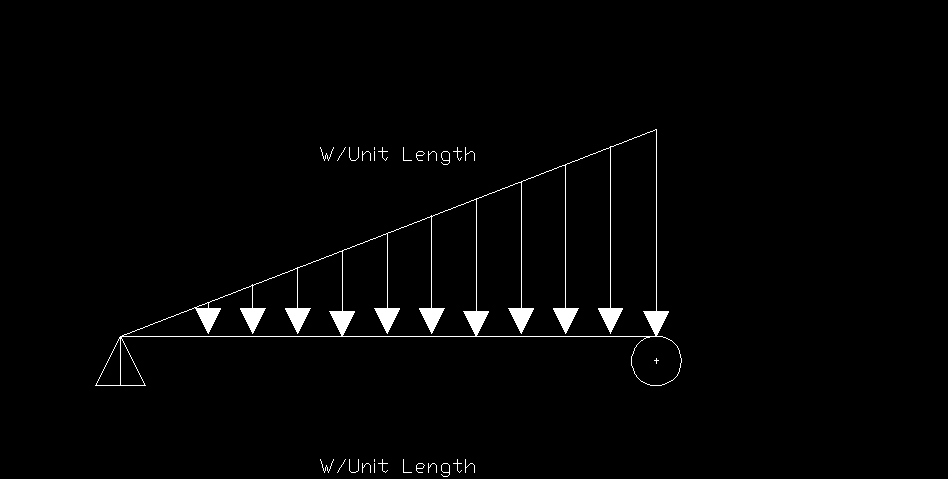
Uniformly Varying Load (Non – Uniformly Distributed Load)
It is that load whose magnitude varies along the loading length with a constant rate.
Uniformly varying load is further divided into two types;
1. Triangular Load
2. Trapezoidal Load
Triangular Load
Triangular load is that whose magnitude is zero at one end of span and increases constantly till the 2nd end of the span. As shown in the diagram;
Trapezoidal Load
Trapezoidal load is that which is acting on the span length in the form of trapezoid. Trapezoid is generally form with the combination of uniformly distributed load (UDL) and triangular load. As shown in the diagram below;
Coupled Load
Coupled
load
is that in which two
equal and opposite forces acts on the same span. The lines of action of
both the forces are parallel
to each other but opposite
in directions.
This type of loading creates a couple load.
Coupled load triy to rotate
the span in case one
load is
slightly more than the 2nd load. If force on one end of beam acts upward then same
force will acts downwards
on the opposite end
of beam.
Coupled load is expressed as kip.m, kg.m, N.m, lb.ft etc.



0 Comments